Responding to the recent tragedy that occurred at Virginia Tech, I have to wonder when the violence begins and how it becomes as pervasive, in our society, as it does. Over this past weekend, I attended a teacher training in Philadelphia. During a conversation with a colleague, I explained that I was going to be working at a certain high school and her response was “Wow—you are really lucky because they have metal detectors there…” Though this high school is not in Baltimore, and I will not be teaching there long term, it made me think about what expectations we set, as a society.
I think Jonah had it right in that “nobody wants to feel like they are entering a high security prison when they arrive at school, but it seems as though this is the direction we are headed.” However, I also believe that our safety may not be from the monitors, cameras and extra personnel he described. I agree that we should look at the root of the problem and help our students find more productive, ways of dealing with their conflicts and emotions that do not include violence. The question then, is how do we know about the violence and what can we do to stop it?
While not the center of my conversation, the metal detector statement stuck in my head. How is it possible that we have allowed people in our society to pervert the Second Amendment’s guarantee of the right to bear arms so badly? What are the expectations we set for our youth and how can we make sure those expectations don’t include an allowance for violence?
According to an article in the Washington Times, 81 percent of the nation's schools experienced one or more violent incidents in 2003-2004, the most recent school year reported by the U.S. Department of Justice. Thirty-six percent of urban school students report gangs in their schools. In 2004-2005, there were 48 school-associated violent deaths of students, staff and non-students, more than double the 21 of the previous school year. These staggering numbers suggest we do not know what to do about the prevalence of violence.
I am not suggesting that we allow the government to set ground rules about adults owning weapons to protect themselves or use for recreational activities, as is constitutionally guaranteed. However, there should be a social norm that shooting your classmates, professors, teachers and/or family members shouldn’t be one of those pastimes which is acceptable.
I am asking, however, if it is fair to use the freedoms guaranteed in our Constitutional rights against us… I recently read an article about a Minnesota high school that not only suspended a student for his creative writing in a creative writing class, but got him institutionalized for several days. Does free speech or expression extend to writing about violence in school? According to officials at Virginia Tech, probably not. Sent to counseling and watched by the authorities, Cho, the VT gunman was allowed back to class, which has been acknowledged as a mistake of prodigious proportions.
How does this connect to Baltimore City? The violence I see every day is pervasive—one high schooler “playin” with another by pushing him against a locker, threats against teachers and more likely at my school, other students, etc. etc. etc. The list goes on and on. This laundry list of violent actions in Baltimore City prompted a school reform effort in the late ‘90’s that has since petered out of high schools in the City. What penalties can be enforced for these students who “play” and how can we make sure that the violence in Baltimore City is curbed? How can make it so the Department of Justice statistic that “almost 10 percent of children in Baltimore and almost 9 percent in Washington, D.C., were afraid to go to school, aren’t afraid anymore? Clearly I don’t have a variety of answers or strategies to implement, but this is worth further discussion, investigation and most importantly, action!
Thursday, April 26, 2007


Wednesday, April 25, 2007
Mixed Messages
For the past two years I have been teaching American Government to high schoolers. American Government just happens to be an HSA tested subject area in the state of Maryland. Maryland adopted the HSA and MSA test format in order to be in compliance with the famous No Child Left Behind Act, or as I like to call it “Every Child That Does Not Do Well On Standardized Test WILL BE LEFT BEHIND.”
So I sucked it up and tried my best to prepare my students for this large standardized test that they would have to take at the end of the year to determine whether or not they graduate…no pressure there. While I was trying to figure out what in the heck a good teacher even does in the classroom I was taking course work at Johns Hopkins to learn what good teaching looks like, and to refine my teaching, so that I could be the best teacher for my students.
For a long while I was bothered by the whole standardized testing craze that the whole country seems to be partaking in, and I could not understand why. I was sitting in one of my classes at Hopkins and my professor was talking about differentiating your instruction as a teacher to best reach all of your students, realizing students learning modalities and playing to them in the classroom, and using different kinds of assessments to allow all students to demonstrate their mastery. It hit me…if this is what good teaching looks like, how come this is no where close to how the powers that be test our students? I would hope that those that are involved in making education policy and those at the Maryland State Department of Education would have in this lifetime or another been an educator for a period of time, so how come they do not see that these standardized tests are not a good way to measure EVERY students mastery of content?
I am sometimes amiss as to why I as a teacher am checked on these aspects of “good teaching” on a daily basis, and yet when it comes down to it, my students will have to show that they really know how to take a standardized test? It causes me as a teacher to not only get the students the material that is on the test, but I also have to take a good amount of time to teach students how to take the test. I spend most of my days on BCR’s and ECR’s, which, lets be honest, students will not see again EVER!
I sometimes feel that I am doing my students a disservice by making lessons which cater to their learning styles and needs, when in the end the state will just look at all the students in Maryland the same and give them the same old test that they give every other student.
To make matters even worse, I have bought into the fact that my students need to pass this test to graduate and it is not going to change anytime soon. So I plug to my students every day the importance of this test and how well they do on it, just to have Nancy Grasmick turn around and say a month before the test is given, that in the end she does not think that they are going to hold students accountable for not taking the test because they have not planned on what they will do with the number of students that will not be graduating because they have not passed the tests! It sometimes makes you wonder if any of the people that are working in the administrative side of education have ever been in the classroom or sat through a Hopkins course as I have to really try and reach all the students in the classrooms across the county.
So I sucked it up and tried my best to prepare my students for this large standardized test that they would have to take at the end of the year to determine whether or not they graduate…no pressure there. While I was trying to figure out what in the heck a good teacher even does in the classroom I was taking course work at Johns Hopkins to learn what good teaching looks like, and to refine my teaching, so that I could be the best teacher for my students.
For a long while I was bothered by the whole standardized testing craze that the whole country seems to be partaking in, and I could not understand why. I was sitting in one of my classes at Hopkins and my professor was talking about differentiating your instruction as a teacher to best reach all of your students, realizing students learning modalities and playing to them in the classroom, and using different kinds of assessments to allow all students to demonstrate their mastery. It hit me…if this is what good teaching looks like, how come this is no where close to how the powers that be test our students? I would hope that those that are involved in making education policy and those at the Maryland State Department of Education would have in this lifetime or another been an educator for a period of time, so how come they do not see that these standardized tests are not a good way to measure EVERY students mastery of content?
I am sometimes amiss as to why I as a teacher am checked on these aspects of “good teaching” on a daily basis, and yet when it comes down to it, my students will have to show that they really know how to take a standardized test? It causes me as a teacher to not only get the students the material that is on the test, but I also have to take a good amount of time to teach students how to take the test. I spend most of my days on BCR’s and ECR’s, which, lets be honest, students will not see again EVER!
I sometimes feel that I am doing my students a disservice by making lessons which cater to their learning styles and needs, when in the end the state will just look at all the students in Maryland the same and give them the same old test that they give every other student.
To make matters even worse, I have bought into the fact that my students need to pass this test to graduate and it is not going to change anytime soon. So I plug to my students every day the importance of this test and how well they do on it, just to have Nancy Grasmick turn around and say a month before the test is given, that in the end she does not think that they are going to hold students accountable for not taking the test because they have not planned on what they will do with the number of students that will not be graduating because they have not passed the tests! It sometimes makes you wonder if any of the people that are working in the administrative side of education have ever been in the classroom or sat through a Hopkins course as I have to really try and reach all the students in the classrooms across the county.
Tuesday, April 24, 2007
landmarks and other things
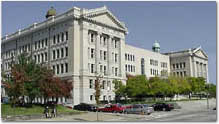
While browsing through headlines in today’s Examiner, I came across one, in particular, that made me smile. “City College Honored as Official Landmark”, it proclaimed, with a picture of what the column cites as, “the castle on the hill.” Though the article is short, and really just focuses on the fact that the building is now, officially, a historic landmark, I found it symbolic, landmark if you will, of my growth during this experience with BCPSS. (I say symbol, here, not analogy. Very tricky.)
My very first trip to Baltimore was for the June job-fair in 2005. I had taught for seven hours that Friday, hopped in my car, and made the normally eight hour—but due to traffic on the George Washington Bridge and Jersey Turnpike turned into eleven hour—trek from Cape Cod to the luxurious Radisson at Cross Keyes only to find out, at 1 a.m., that my room was not available until Saturday night. At which point I was sent, exhausted, hungry, and soaking wet (for dramatic effect solely—though I do think it rained during my ride at some point), to a Holiday Inn forty-five minutes out of town. There I paid the front desk $110 for the only room, the penthouse suite, to rest my head for four hours.
I was going to the BCPSS job-fair in the morning. How very exciting.
Half asleep, awkwardly dressed in a new suit and heels, I stumbled up to City College’s table like a ten-year-old girl at a basketball banquet, donned in her older sister’s hand-me-downs and unaware. Shoulder pads, disheveled hair, no make up, frightened expression, silently rehearsing “don’t trip, don’t trip, …” while desperately trying to walk steady in uncomfortable shoes. I reached out my hand, introduced myself, and handed the then department head my resume. And after a brief “you outta be in movies, kid” sort of exchange, I was hired on the spot.
First interview. Done.
Excited to check into my actual hotel room and get some more sleep, I brought my papers to the TFA table, packed up my things, and got ready to go. That is, after I interviewed with a different school because apparently City College didn’t “need” me. So fine, I stumble up to the next available table without a line, Harbor City High School. And in a used-car salesman type pitch, I was, again, hired on the spot.
Second interview. Done.
Think: I chose the path less traveled by. And that has made all the difference.
About two weeks into my first year at Harbor City I began to resent City College and all that it stood for. I’d drive past it on my way home from the grocery store and scowl. Or I’d be stuck in traffic on 33rd and stare up at it’s majestic stone walls with ivy climbing them and think “now that’s a real school.” I’d even dream, some nights, of walking through the halls wearing a plaid coat with leather elbows, listening to students recite Robert Frost and wake up smiling. And bitter. I was so convinced early on that my struggles were simply because I was at the “wrong” school. That if I could just get back into the “castle on the hill,” I’d be golden. Literally. Thankfully, however, reality hit and I recognized that, despite appearances, even the best schools in Baltimore were dealing with some rough spots. Even City was rumored to have lowered test scores to maintain acceptance rates. Even City had teachers with classroom management issues.
Even City, despite being a castle, was no fairytale.
During the ceremony Baltimore Police Commissioner Leonard Hamm states, “A school is more than ivy-covered walls and buildings. It’s about the people as well.” I couldn’t agree more. I think the big push in Baltimore right now is to create the appearance of learning. Is to create the appearance of success. Is to advertise. And to fool. The problems in our schools are solvable. Most of them.
But none of them will be fixed until we—and I use we loosely (administrators, city officials, anyone?) admit to serious issues in such a way that we are forced to do more than in-home repairs.
But, how do you bulldoze a historic landmark?
My very first trip to Baltimore was for the June job-fair in 2005. I had taught for seven hours that Friday, hopped in my car, and made the normally eight hour—but due to traffic on the George Washington Bridge and Jersey Turnpike turned into eleven hour—trek from Cape Cod to the luxurious Radisson at Cross Keyes only to find out, at 1 a.m., that my room was not available until Saturday night. At which point I was sent, exhausted, hungry, and soaking wet (for dramatic effect solely—though I do think it rained during my ride at some point), to a Holiday Inn forty-five minutes out of town. There I paid the front desk $110 for the only room, the penthouse suite, to rest my head for four hours.
I was going to the BCPSS job-fair in the morning. How very exciting.
Half asleep, awkwardly dressed in a new suit and heels, I stumbled up to City College’s table like a ten-year-old girl at a basketball banquet, donned in her older sister’s hand-me-downs and unaware. Shoulder pads, disheveled hair, no make up, frightened expression, silently rehearsing “don’t trip, don’t trip, …” while desperately trying to walk steady in uncomfortable shoes. I reached out my hand, introduced myself, and handed the then department head my resume. And after a brief “you outta be in movies, kid” sort of exchange, I was hired on the spot.
First interview. Done.
Excited to check into my actual hotel room and get some more sleep, I brought my papers to the TFA table, packed up my things, and got ready to go. That is, after I interviewed with a different school because apparently City College didn’t “need” me. So fine, I stumble up to the next available table without a line, Harbor City High School. And in a used-car salesman type pitch, I was, again, hired on the spot.
Second interview. Done.
Think: I chose the path less traveled by. And that has made all the difference.
About two weeks into my first year at Harbor City I began to resent City College and all that it stood for. I’d drive past it on my way home from the grocery store and scowl. Or I’d be stuck in traffic on 33rd and stare up at it’s majestic stone walls with ivy climbing them and think “now that’s a real school.” I’d even dream, some nights, of walking through the halls wearing a plaid coat with leather elbows, listening to students recite Robert Frost and wake up smiling. And bitter. I was so convinced early on that my struggles were simply because I was at the “wrong” school. That if I could just get back into the “castle on the hill,” I’d be golden. Literally. Thankfully, however, reality hit and I recognized that, despite appearances, even the best schools in Baltimore were dealing with some rough spots. Even City was rumored to have lowered test scores to maintain acceptance rates. Even City had teachers with classroom management issues.
Even City, despite being a castle, was no fairytale.
During the ceremony Baltimore Police Commissioner Leonard Hamm states, “A school is more than ivy-covered walls and buildings. It’s about the people as well.” I couldn’t agree more. I think the big push in Baltimore right now is to create the appearance of learning. Is to create the appearance of success. Is to advertise. And to fool. The problems in our schools are solvable. Most of them.
But none of them will be fixed until we—and I use we loosely (administrators, city officials, anyone?) admit to serious issues in such a way that we are forced to do more than in-home repairs.
But, how do you bulldoze a historic landmark?
A Look at Contract Negotiations for Principals
In a New York Times article today, there was a report of a tentative agreement between the Bloomberg administration and the union representing
Stunned by this 6-digit figure, I wondered how, and if, this compares to incentives being offered to teachers. Now, despite a lot of bad stories and experiences with administrators, I do believe that a good administrator could come into a struggling school and make a big difference. The power they wield over making decisions and influencing teacher and student behavior makes that seem theoretically possible. And maybe an administrator could have a much larger effect on a school as a whole than one teacher could. However, shouldn’t something comparable be done to draw good teachers to struggling schools?
Currently, new, highly-qualified math or science teachers who begin teaching in
It seems to me that most teachers in
"What Teaching Really Takes"
I often viewed those movies such as “Freedom Writers,” “Dangerous Minds,” and “Stand and Deliver” with a kind of awe before I began teaching. Now, as a teacher, I really did not know what to think of them. Do they portray urban youth correctly? Do they portray urban teachers correctly? My answer to both was no, but I could not really describe why. I knew I was not seeing my reality on a movie screen. But if asked what needed to be changed, I could not quite pinpoint my argument. Thankfully, in an article first published in the New York Times and later reprinted in American Educator , tenth grade teacher Tom Moore explains it more eloquently than I ever could have.
Perhaps my favorite part of the article is when Moore discusses Hilary Swank’s character in “Freedom Writers.” He says that as soon as a fight breaks out in her classroom, the security guard appears immediately. Has this ever happened to anyone? He goes on to say that the only people running down the hall in his school would be kids because they heard about a fight. Now that sounds more like it.
But the main point of Moore’s article is what he calls “The Myth of the Great Teacher.” Basically, these movies portray “good” teachers as people who martyr themselves to the cause. They give up their personal lives, spend all their time and money on their students, and expect nothing in return. Also, these movies portray urban youth as simply needing someone to believe in them. Forget the basic skills, just give them a hug and a smile and everything will be fine.
But what does it matter? It’s Hollywood. Nobody really believes that movies portray real life, right? But as Moore puts it, “no one believes that hospitals are like ER…[but] no one blames doctors for the failure of the healthcare system.”
However, our profession is constantly trivialized and the idea that love and dedication will overcome is broadcast. I don’t want to be considered a terrible person because I expect to get paid for my job, and I expect to have a life outside of my classroom. Just because I am part of a system that is not successful does not mean that it is my fault. I couldn’t fix it by giving up my life, even if I wanted to.
(Unfortunately, I cannot find a free link to this article online, but it is available from the New York Times. It is entitled “Movie Fantasy vs. Classroom Reality: What Teaching Really Takes.”)
Perhaps my favorite part of the article is when Moore discusses Hilary Swank’s character in “Freedom Writers.” He says that as soon as a fight breaks out in her classroom, the security guard appears immediately. Has this ever happened to anyone? He goes on to say that the only people running down the hall in his school would be kids because they heard about a fight. Now that sounds more like it.
But the main point of Moore’s article is what he calls “The Myth of the Great Teacher.” Basically, these movies portray “good” teachers as people who martyr themselves to the cause. They give up their personal lives, spend all their time and money on their students, and expect nothing in return. Also, these movies portray urban youth as simply needing someone to believe in them. Forget the basic skills, just give them a hug and a smile and everything will be fine.
But what does it matter? It’s Hollywood. Nobody really believes that movies portray real life, right? But as Moore puts it, “no one believes that hospitals are like ER…[but] no one blames doctors for the failure of the healthcare system.”
However, our profession is constantly trivialized and the idea that love and dedication will overcome is broadcast. I don’t want to be considered a terrible person because I expect to get paid for my job, and I expect to have a life outside of my classroom. Just because I am part of a system that is not successful does not mean that it is my fault. I couldn’t fix it by giving up my life, even if I wanted to.
(Unfortunately, I cannot find a free link to this article online, but it is available from the New York Times. It is entitled “Movie Fantasy vs. Classroom Reality: What Teaching Really Takes.”)
Monday, April 23, 2007
NPR's Take On B'more's Small School Reform
Just two weeks ago Baltimore City teachers and students we enjoying a much need time off. It was Spring Break! While some teachers hung around B’more, and others visited exotic destinations like the Dominican Republic and Turkey, I chose to drive 16 hours to visit my sister in Mississippi. It was on the return trip that I was privy to something that both excited and frustrated me.
Throughout my drive I entertained myself with the exhilarating guitar riffs of Led Zeppelin, episodes of the highly acclaimed television drama “Battlestar Galactica, and doses of NPR’s Morning Edition and All Things Considered. Having been addicted to my local NPR affiliate over the past two years, it was comforting being able to tune into these staples of news as I made my trip across the country. On Wednesday, April 11th just thirty miles outside of Memphis, NPR broadcasted a story as part of “Tales from Northwestern,” their continuing series examining the impact of No Child Left Behind and urban school reform through the lens of Northwestern High School here in Baltimore City.
This particular story focused on the small school/learning community movement that has become popular in pretty much any urban setting across the country. When Steve Inskeep read the plug for the story “Trouble Schools Turn Around by Shrinking” I was excited. I thought, “Great NPR will present an objective look at the small school movement in Baltimore City!” By the end of the story I was no longer excited, but frustrated and very disappointed.
The story begins by describing how the idea of the large comprehensive high school like Northwestern was a response the need to educate the baby boomers while reducing cost by eliminating redundancies in administrations. But, now in the modern urban setting they fail to appropriately education our children. The story showcases several small schools in Baltimore including Digital Harbor High School and Baltimore Talent Development High School. It touts the benefits of smaller schools including the ability to “reduce overhead.” Additionally, “’New schools are just easier,’ . . . Comprehensive high schools are more challenging, because "the number of supports that you need in these comprehensive high schools are significant.’” The CEO is even interviewed where she discusses Baltimore’s larger plan for developing many smaller high schools throughout the city"
. . .there will be no more "zoned schools." Instead, she says, Baltimore students will be able to choose their school, "understanding that they can go to the school that will help them implement their career options and choices."
The story presents a pretty rosy picture of the state of the small high schools in Baltimore city, and a doomsday one for the large comprehensive high schools. Nevermind that two of the best schools in the state of Maryland are comprehensive schools located in Baltimore. Based on the evidence in this story it would seem that moving to a small school model would be a no-brainer, but unfortunately it is far from reality. All it would take is to ask a teacher at one of Baltimore’s many other small schools to see not all is as it may seem. Even their description of Digital Harbor seems a bit from the truth when you talk with a teacher that works there.
What frustrates me the most about this story is that it reflects what seems to be a common theme in the media – small schools are perfect. Article after article, and story after story seem to present small schools as the cure-all to the educational problems afflicting our urban youth. Nowhere in the media have I seen an honest and open discussion of the painful realities of these small learning communities.
This story by NPR and many like it seem to say that the comprehensive high school has nothing going for it. But is that really true? After all how many of us went to a comprehensive high school? Is it really the large school model that inhibits our students from getting the education they need and deserve or is it something else? After all I teach at a “small” school that doesn’t seem any more successful than Northwestern. What really causes a school to succeed? Are small schools really cheaper to run?
I see this article as a warning sign to where the small school movement is leading us: All we need to do, and all we will do, is make the schools smaller and this will lead our students to academic success. This is wrong, and it is the easy out that many of us would like to take in order to avoid asking the hard questions.
Large or small there are benefits. Large or small there are disadvantages. But, large or small, schools must be run right or, large or small, any school can fall. But, if they are run right then, large or small, any school can stand tall.
Throughout my drive I entertained myself with the exhilarating guitar riffs of Led Zeppelin, episodes of the highly acclaimed television drama “Battlestar Galactica, and doses of NPR’s Morning Edition and All Things Considered. Having been addicted to my local NPR affiliate over the past two years, it was comforting being able to tune into these staples of news as I made my trip across the country. On Wednesday, April 11th just thirty miles outside of Memphis, NPR broadcasted a story as part of “Tales from Northwestern,” their continuing series examining the impact of No Child Left Behind and urban school reform through the lens of Northwestern High School here in Baltimore City.
This particular story focused on the small school/learning community movement that has become popular in pretty much any urban setting across the country. When Steve Inskeep read the plug for the story “Trouble Schools Turn Around by Shrinking” I was excited. I thought, “Great NPR will present an objective look at the small school movement in Baltimore City!” By the end of the story I was no longer excited, but frustrated and very disappointed.
The story begins by describing how the idea of the large comprehensive high school like Northwestern was a response the need to educate the baby boomers while reducing cost by eliminating redundancies in administrations. But, now in the modern urban setting they fail to appropriately education our children. The story showcases several small schools in Baltimore including Digital Harbor High School and Baltimore Talent Development High School. It touts the benefits of smaller schools including the ability to “reduce overhead.” Additionally, “’New schools are just easier,’ . . . Comprehensive high schools are more challenging, because "the number of supports that you need in these comprehensive high schools are significant.’” The CEO is even interviewed where she discusses Baltimore’s larger plan for developing many smaller high schools throughout the city"
. . .there will be no more "zoned schools." Instead, she says, Baltimore students will be able to choose their school, "understanding that they can go to the school that will help them implement their career options and choices."
The story presents a pretty rosy picture of the state of the small high schools in Baltimore city, and a doomsday one for the large comprehensive high schools. Nevermind that two of the best schools in the state of Maryland are comprehensive schools located in Baltimore. Based on the evidence in this story it would seem that moving to a small school model would be a no-brainer, but unfortunately it is far from reality. All it would take is to ask a teacher at one of Baltimore’s many other small schools to see not all is as it may seem. Even their description of Digital Harbor seems a bit from the truth when you talk with a teacher that works there.
What frustrates me the most about this story is that it reflects what seems to be a common theme in the media – small schools are perfect. Article after article, and story after story seem to present small schools as the cure-all to the educational problems afflicting our urban youth. Nowhere in the media have I seen an honest and open discussion of the painful realities of these small learning communities.
This story by NPR and many like it seem to say that the comprehensive high school has nothing going for it. But is that really true? After all how many of us went to a comprehensive high school? Is it really the large school model that inhibits our students from getting the education they need and deserve or is it something else? After all I teach at a “small” school that doesn’t seem any more successful than Northwestern. What really causes a school to succeed? Are small schools really cheaper to run?
I see this article as a warning sign to where the small school movement is leading us: All we need to do, and all we will do, is make the schools smaller and this will lead our students to academic success. This is wrong, and it is the easy out that many of us would like to take in order to avoid asking the hard questions.
Large or small there are benefits. Large or small there are disadvantages. But, large or small, schools must be run right or, large or small, any school can fall. But, if they are run right then, large or small, any school can stand tall.
Could communities be to blame for Baltimore’s failing schools?
In a city where less than 15% of the adults 18-25 are enrolled in colleges or universities and less than 40% graduate high school, education in Baltimore is in crisis. In the article, “Get Real: Here’s the Boost that Poor Children, their Teachers and their Schools Really Need” from the Spring 2007 issue of American Educator, Antonia Cortes explains that one of the major problems causing the education gap in cities like Baltimore is the socio-economic status of our students. Cortes goes on to explain that children from low-income households are three times as likely to score in the “bottom quartile on assessments of reading, math, and general knowledge” than are children from middle or upper class households. As children progress to the higher grades, this education gap increases as middle and upper class students read and learn over the summer vacation while children from lower-income households often do not. As a result, low-income students will graduate at a much lower level than their peers if they do not receive a better-than-average and highly accelerated education.
Unfortunately, I believe that Cortese is correct in looking to the environments where our children spend 17 hours per day for 185 days each year, for answers to the education crisis in Baltimore City. In many cases, I have met with parents who make it clear that education is not a priority and since many of our student’s parents have not graduated high school, it is impossible to expect that it would be. As a result, our children are not getting the support they need at home in order to be successful at school. In fact, many of our children see a greater financial benefit to dropping out of school than continuing on to graduation. As educators it sometimes feels like our hands are tied. We can provide students with extra help and knowledge based curricula taught by highly qualified teachers in a positive and well organized classroom, but we can only keep students in that environment for seven hours a day, five days a week. We cannot help what a student does or does not do once he or she gets home.
As a result of my desire to untie my hands and close the education gap, I was excited to read Cortese’s article, hoping to find some new and innovative approaches to teaching students with a low socio-economic status. Unfortunately, what I found in Cortese’s article were more “band-aid” solutions such as improving teacher quality, creating a culture of respect among students and providing knowledge rich curricula. While I agree that these strategies are a step in the right direction, I cannot help but think that urban school districts, Baltimore included, are blatantly ignoring the larger community issues that may be contributing to this education gap.
In communities where drug deals, murders and high school drop outs can be found around nearly every corner it is hard to ignore the impact that Baltimore City has on our students. If Baltimore continues to ignore the relationship between our failing schools and the problems in our urban communities, we will continue to do a disservice to our children. Until BCPSS and the Baltimore City government recognize that improving city schools needs to be a joint, community based effort, than we will never be able to close the learning gap. Unfortunately, it seems that much like Antonia Cortese and her “new ideas for urban reform,” neither BCPSS nor Baltimore City itself are willing to put in the effort to improve the conditions of our urban neighborhoods therefore deciding to put a million band-aids on the problem rather than face the enormity and complexities of the truth behind our failing schools.
I do not pretend to know what the answer is for improving Baltimore City schools, but I do know that ignoring the issue and pretending it does not relate to the problems in our communities is doing a huge disservice to our children and expanding the educational gap.
AFT - Publications - American Educator - Spring 2007 - Get Real
Unfortunately, I believe that Cortese is correct in looking to the environments where our children spend 17 hours per day for 185 days each year, for answers to the education crisis in Baltimore City. In many cases, I have met with parents who make it clear that education is not a priority and since many of our student’s parents have not graduated high school, it is impossible to expect that it would be. As a result, our children are not getting the support they need at home in order to be successful at school. In fact, many of our children see a greater financial benefit to dropping out of school than continuing on to graduation. As educators it sometimes feels like our hands are tied. We can provide students with extra help and knowledge based curricula taught by highly qualified teachers in a positive and well organized classroom, but we can only keep students in that environment for seven hours a day, five days a week. We cannot help what a student does or does not do once he or she gets home.
As a result of my desire to untie my hands and close the education gap, I was excited to read Cortese’s article, hoping to find some new and innovative approaches to teaching students with a low socio-economic status. Unfortunately, what I found in Cortese’s article were more “band-aid” solutions such as improving teacher quality, creating a culture of respect among students and providing knowledge rich curricula. While I agree that these strategies are a step in the right direction, I cannot help but think that urban school districts, Baltimore included, are blatantly ignoring the larger community issues that may be contributing to this education gap.
In communities where drug deals, murders and high school drop outs can be found around nearly every corner it is hard to ignore the impact that Baltimore City has on our students. If Baltimore continues to ignore the relationship between our failing schools and the problems in our urban communities, we will continue to do a disservice to our children. Until BCPSS and the Baltimore City government recognize that improving city schools needs to be a joint, community based effort, than we will never be able to close the learning gap. Unfortunately, it seems that much like Antonia Cortese and her “new ideas for urban reform,” neither BCPSS nor Baltimore City itself are willing to put in the effort to improve the conditions of our urban neighborhoods therefore deciding to put a million band-aids on the problem rather than face the enormity and complexities of the truth behind our failing schools.
I do not pretend to know what the answer is for improving Baltimore City schools, but I do know that ignoring the issue and pretending it does not relate to the problems in our communities is doing a huge disservice to our children and expanding the educational gap.
AFT - Publications - American Educator - Spring 2007 - Get Real
Sunday, April 22, 2007
The Much Needed Re-Desegregation of Our Schools
If the desegregation of schools happened over a half a century ago in 1954, why is it that I have only seen three white faces in my
The article posits that there has been overwhelming evidence proving the benefits of racially integrated schools. Integration not only improves the “quality of learning outcomes for minority students,” (“The Supreme Court and School Desegregation”), but the students also perform better in college attendance and employment than students of non-integrated schools. While the academic benefits of desegregated schools have been proven through studies and are unlikely to be contended, what I find to be equally important, though rarely referenced in such cases, is the values of tolerance and cultural awareness. These are two often underestimated factors in their ability to foster open-mindedness and critical thinking abilities, not to mention basic social functioning. Biologically, animals are enticed to reject difference, and this is the basis of the psychological tenet of in-group bias. By students learning to combat this somewhat natural feeling, they are learning to master their baser instincts and think critically about how they respond to any type of stimulus, racial or not.
Many teachers in
I was curious about the statistics of segregation in Baltimore City Public Schools, and I came across an article that references
The achievement gap is undoubtedly the underlying cause of whites tending to group together, based on lower-performing African-American districts. This puts us at a catch-22. If controlled choice is struck down, we deepen the rift between opportunity for a decent education. This is why maintaining controlled choice seems to the only effective way to fight this uphill battle.
Please visit the following links to read the articles referenced above:
“Lost Learning, Forgotten Promises”:
http://www.americanprogress.org/issues/2006/11/lostlearning.html
“The Supreme Court and School Desegregation”:
http://www.americanprogress.org/issues/2006/11/desegregation.html
“Race in American Public Schools: Rapidly Resegregating
False Claims: Advocating for Reform
In the Education Week article, “Bush Claims About NCLB Questioned,” another look is taken at judging the effectiveness of the law. In New Albany, President Bush spoke to his audience about the successes of his self-boasted greatest policy imitative to date, No Child Left Behind. However, as we see each day in our classroom and at an even larger level in Baltimore City, data can be obstructed to make any child or school system look like they are making gains.
Bush and his supporters claim that student achievement is increasing due to the law. With no substantial evidence supported by any accredited research or institution, it is hard to believe that this boast is still being made. As the date approaches for the renewal of NCLB, one has to question why our lawmakers are not asking for more supporting or damning evidence. When the leading educational institutions, such as Harvard’s Department of Education, speak out on the lack of evidence to support NCLB, is there any hope that our schools will not be under the supervision of NCLB in the near future? Probably not.
With any full-scale reform effort, we have learned that we are still in the trial period and have not fully seen this reform through. However, we also know that it is impossible to have a successful reform without full participation. So, if several teachers are not being certified to become “highly qualified” across the country since they or the administrations are not invested in NCLB, then how will this reform ever get to the next stage. Answer: teach to the test. A teacher needs limited content knowledge to teach test taking skills.
Safety in our Schools
In response to the recent tragedy at Virginia Tech, there has been extensive discussion about the issue of school safety. Of course this is not a new discussion in Baltimore City, but this event is a painful reminder that school safety must be a top priority when it comes to school reform. The question of how to improve school safety, however, is not an easy one to answer. Most school violence originates outside of school buildings, but increasingly it is making its way into our corridors and classrooms. Nobody wants to feel like they are entering a high security prison when they arrive at school, but it seems as though this is the direction we are headed.
As Sara Neufold describes in her article, “10 More City Schools to get Surveillance,” it seems that blanketing our schools with digital video cameras is the most recent strategy to combat school violence. Within the last year, over two million dollars have been spent installing video cameras at Baltimore City public schools. How affective have these cameras been as a deterrent? I was shocked to find out that with 99 video cameras, my school now has more cameras than any other school in the city. In theory, no part of the building should be unmonitored. Unfortunately, however, this year has been far more violent than last, and rarely do the cameras help school police apprehend offenders. One reason for this is that many of the cameras no longer work properly.
School officials and police can monitor school grounds by watching a wall of screens in our school police office. However, as one BCPSS principal replied when asked who watches the monitors, "I wish we had someone to do that. We are instructional leaders. We are in the classroom." In other words, even if the technology worked correctly, no one is hired to watch the monitors so no one is there to notice when crimes are unfolding. Occasionally police can use the video footage as evidence in after-the-fact, but by then the damage has already been done.
In the words of Kenneth Trump, president of a Cleveland-based safety consulting firm, “security equipment is only as good as the human effort behind it.” This is also true of metal detectors, which is another strategy that has received much attention of late. Clearly, technology alone cannot solve the problem. We must also invest human capital to improve school safety. Most importantly, we must address the root of the problem and help our students find more productive, and less violent ways of dealing with their conflicts and emotions. Without this effort, all of the security equipment in the world won’t save us.
Please visit the following link to read the article referenced above:
http://www.populistamerica.com/10_more_city_schools_to_get_surveillance
As Sara Neufold describes in her article, “10 More City Schools to get Surveillance,” it seems that blanketing our schools with digital video cameras is the most recent strategy to combat school violence. Within the last year, over two million dollars have been spent installing video cameras at Baltimore City public schools. How affective have these cameras been as a deterrent? I was shocked to find out that with 99 video cameras, my school now has more cameras than any other school in the city. In theory, no part of the building should be unmonitored. Unfortunately, however, this year has been far more violent than last, and rarely do the cameras help school police apprehend offenders. One reason for this is that many of the cameras no longer work properly.
School officials and police can monitor school grounds by watching a wall of screens in our school police office. However, as one BCPSS principal replied when asked who watches the monitors, "I wish we had someone to do that. We are instructional leaders. We are in the classroom." In other words, even if the technology worked correctly, no one is hired to watch the monitors so no one is there to notice when crimes are unfolding. Occasionally police can use the video footage as evidence in after-the-fact, but by then the damage has already been done.
In the words of Kenneth Trump, president of a Cleveland-based safety consulting firm, “security equipment is only as good as the human effort behind it.” This is also true of metal detectors, which is another strategy that has received much attention of late. Clearly, technology alone cannot solve the problem. We must also invest human capital to improve school safety. Most importantly, we must address the root of the problem and help our students find more productive, and less violent ways of dealing with their conflicts and emotions. Without this effort, all of the security equipment in the world won’t save us.
Please visit the following link to read the article referenced above:
http://www.populistamerica.com/10_more_city_schools_to_get_surveillance
Where Are My Students?
In a Baltimore Sun article this week, some “errors” were found in the city’s school budget which was approved by board members last month. The budget showed the current student enrollment to be 1,000 more students than are actually enrolled. The error was corrected this week, but the implications of a mistake that large are frightening. According to the Sun, at least 10 million dollars would be at stake with that kind of miscalculation of enrollment.
Now we all know this isn’t the first time Baltimore City Public Schools has made a mistake, but this particular mistake made me think of a related issue that has been of concern to me lately. That issue is student attendance. I have a question (don’t worry it’s hypothetical). Where are my students? My daily attendance in class is about half of what I have on my roll. When I start my first period, there are usually only 5 or 6 students seated before me. I am a huge supporter of small class sizes, but this is ridiculous. There are at least 10 other students on my roll who are not present on a daily basis. I know first period starting at 9:00 am can be hard to get to, but this isn’t a symptom of only my first class. There are at least 8-10 students missing daily in my other classes as well. This has posed a problem for me all year. I can’t get students to master objectives when they aren’t at school on a regular basis. And I certainly can’t see passing them on to English II when they’ve only attended English I 45 days of the year.
I had a conversation with a co-worker about this problem with attendance recently. She told me that the students who missed her class a lot were actually quite smart. They showed up on an HSA practice day and passed the exam that so many of our regularly-attending students cannot pass. What does this say? Have the smart kids figured something out about the quality of education in Baltimore? Or are they simply not being challenged in the courses they have, so they see no point in coming to school? I’m not sure.
Even if the quality of courses isn’t the best in Baltimore, I believe students need to be in school on a daily basis. Currently, at my school, the approach to improving attendance consists of threats about being dropped of the roll for poor attendance over the intercom. The problem is that the only students who hear these threats are the ones who are at school every day. In addition, teachers are asked to call the homes of students who are absent, but (this is nothing new) getting a working number for a student who has missed 20 days in a quarter is difficult to do. It scares me when I look at my attendance book and see so many absences. I worry about where those missing students actually are, what they are doing and what their future holds for them without an education. Dropping students off the roll takes care of one thing: making attendance numbers look better. What worries me is how those names that just disappear from our attendance list will affect this city’s future and the future of its education system. If these students see school as a waste of their time, something needs to be done to make them see the importance and value of education again.
Now we all know this isn’t the first time Baltimore City Public Schools has made a mistake, but this particular mistake made me think of a related issue that has been of concern to me lately. That issue is student attendance. I have a question (don’t worry it’s hypothetical). Where are my students? My daily attendance in class is about half of what I have on my roll. When I start my first period, there are usually only 5 or 6 students seated before me. I am a huge supporter of small class sizes, but this is ridiculous. There are at least 10 other students on my roll who are not present on a daily basis. I know first period starting at 9:00 am can be hard to get to, but this isn’t a symptom of only my first class. There are at least 8-10 students missing daily in my other classes as well. This has posed a problem for me all year. I can’t get students to master objectives when they aren’t at school on a regular basis. And I certainly can’t see passing them on to English II when they’ve only attended English I 45 days of the year.
I had a conversation with a co-worker about this problem with attendance recently. She told me that the students who missed her class a lot were actually quite smart. They showed up on an HSA practice day and passed the exam that so many of our regularly-attending students cannot pass. What does this say? Have the smart kids figured something out about the quality of education in Baltimore? Or are they simply not being challenged in the courses they have, so they see no point in coming to school? I’m not sure.
Even if the quality of courses isn’t the best in Baltimore, I believe students need to be in school on a daily basis. Currently, at my school, the approach to improving attendance consists of threats about being dropped of the roll for poor attendance over the intercom. The problem is that the only students who hear these threats are the ones who are at school every day. In addition, teachers are asked to call the homes of students who are absent, but (this is nothing new) getting a working number for a student who has missed 20 days in a quarter is difficult to do. It scares me when I look at my attendance book and see so many absences. I worry about where those missing students actually are, what they are doing and what their future holds for them without an education. Dropping students off the roll takes care of one thing: making attendance numbers look better. What worries me is how those names that just disappear from our attendance list will affect this city’s future and the future of its education system. If these students see school as a waste of their time, something needs to be done to make them see the importance and value of education again.
Saturday, April 21, 2007
The "Baggage" they Bring
I'm really glad that in Bill Ferguson's post in early April, he linked to the ABC Newsline broadcast comparing "The Wire" to the reality at Baltimore middle schools. I had heard about that segment, but never had the opportunity to view it in it's entirety until I watched it this morning. I have similar mixed feelings regarding the ABC show's racialized depictions of Baltimore. They significantly gloss over the fact that the middle school that they visited (what middle school wears navy polos? I would love to know which school they went to) was under control and teachers were teaching. This directly contradicts their opening assertion that middle school is where it all falls apart. Clearly in some cases, it doesn't. Why didn't they talk about what makes for a successful middle school in Baltimore and what factors indicate failure? That would have been a more interesting and honest angle to pursue. Also, I was troubled by an administrator's statement that the students bring so much baggage (and so few schoolbooks!) that we cannot expect them to perform. It's true that many students face significant problems in their home lives, but many of those same students cling to school as a stabilizing force in their lives. We cannot excuse them for our expectations because of what they are going through. Perhaps we can modify what we want for severely troubled students, but to say that we don't expect them to do anything is ridiculous.
City Paper has an interesting cover story this week that examines the plight of one family whose children bring the "baggage" to school mentioned by the administrator on the Newsline report. The reporter Erin Sullivan follows the saga of a West Baltimore family who are run out of their Section 8 house by local corner boys who think that they are "snooty" for not doing drugs and going to school. An altercation occurs between the father and son of the family and two corner boys that results in a minor shooting, the family's house is firebombed, and they drift around for three months trying to get a new housing unit. Navigating the dead-end bureaucracy of city agencies, they family is final able to find a new unit and pull their lives back together. All throughout the piece, Sullivan refers to how much the children want to go back to school and pick up their studies. She makes it sound as though that is their lifeline to normalcy and the site of many of their dreams. And the children are by no means perfect, all but the youngest have criminal records (possession, assault, gun charges), and they have lived amidst drug dealers and users all of their lives. Still though they reach out to school as a stabilizing influence. The family's story speaks volumes about the attitudes of our students. All but the most jaded see some value in education. They are simply not able to translate that abstract value or purpose into consistent, concrete action. They know how to do right, it's just a matter of getting through all of the mess to allow them to do so.
It seems as though one service that could be added into the all-ready strained budget of our schools is a program that would teach students how to function in school. How do you sit, take notes, organize information, make a study schedule, ask pertinent questions? But most importantly, how do you do all of those things in the face of adversity and contingency? I envision that this kind of program would be entirely practical and get students to think about what they are going to have to do in each situation to maintain their focus and success. Maybe I'll just try and propose this at the next school board meeting...
City Paper has an interesting cover story this week that examines the plight of one family whose children bring the "baggage" to school mentioned by the administrator on the Newsline report. The reporter Erin Sullivan follows the saga of a West Baltimore family who are run out of their Section 8 house by local corner boys who think that they are "snooty" for not doing drugs and going to school. An altercation occurs between the father and son of the family and two corner boys that results in a minor shooting, the family's house is firebombed, and they drift around for three months trying to get a new housing unit. Navigating the dead-end bureaucracy of city agencies, they family is final able to find a new unit and pull their lives back together. All throughout the piece, Sullivan refers to how much the children want to go back to school and pick up their studies. She makes it sound as though that is their lifeline to normalcy and the site of many of their dreams. And the children are by no means perfect, all but the youngest have criminal records (possession, assault, gun charges), and they have lived amidst drug dealers and users all of their lives. Still though they reach out to school as a stabilizing influence. The family's story speaks volumes about the attitudes of our students. All but the most jaded see some value in education. They are simply not able to translate that abstract value or purpose into consistent, concrete action. They know how to do right, it's just a matter of getting through all of the mess to allow them to do so.
It seems as though one service that could be added into the all-ready strained budget of our schools is a program that would teach students how to function in school. How do you sit, take notes, organize information, make a study schedule, ask pertinent questions? But most importantly, how do you do all of those things in the face of adversity and contingency? I envision that this kind of program would be entirely practical and get students to think about what they are going to have to do in each situation to maintain their focus and success. Maybe I'll just try and propose this at the next school board meeting...
Friday, April 20, 2007
Gender Segregated Schools
This is my first blog ever! :) I guess this is my first chance to vent/dicsuss/BLOG an educational issue that I have thought quite a bit about. As soon as the topic of segregation in public schools arises most people shutter to think that it may actually be a research based innovation that may actually result in significant increases in student achievement. There is a bit of internal conflict as an urban educator when the issue of segregation in public education facilities arises. However, the segregation I speak of is not demeaning, belittling, ethically, or racially motivated. Gender segregation is a research based change of traditional education that may not be as radical as we think. It is certainly an interesting concept, and worth some thought and debate. I guess the thing about NCLB that makes the most sense, but is often time misinterpreted, is the ‘innovative’ factor. BCPSS annually implements changes that are little more than the Federal minimum as far as changes that will produce serious results.
What is the motivating factor for deviant or inappropriate behavior from our students? Girls are catty to impress the boys and boys show off to impress the girls. I find that often fights, arguments, and classroom disruptions are between boys and girls, and if they are same sex arguments, it is over the opposite sex. If that variable were eliminated, would student achievement benefit? Let’s look at the research…
A voluntary pilot program in Pennsylvania’s Erie School District has found that students in gender-separated classes improve in both academics and behavior.
The federal government (NCLB) is going to make it easier to experiment with same gender education. Presently, there are 223 public schools offering single-sex classrooms. There were four eight years ago.
Boys and girls learn and process information differently. Boys respond to direction and motion. Girls respond to detail and color. Girls are more likely to learn sitting still and boys do better if they can move around and work with their hands.
Deland, Florida experimented with same-sex classrooms vs. co-ed. The state writing test was administered to both groups. In the co-ed class, 37% of the boys passed and 86% passed in the same-sex environment. In the co-ed class, 57% of girls passed the writing test and 75% passed in the same-sex class. Judging from just this one statistic, same-sex classes are more helpful to boys than girls although it helps both.
(Research taken from http://educationalissues.suite101.com/)
How about Baltimore City? Western high school is currently all female and is one of the oldest in the country. Here is how Western compares to the other same sex high schools in Baltimore City:
Western Baltimore City
Grad rate 97.1 60.6
Attention: 94 83
HSA English 85 37
Drop out rate 1.12 (5 year high) 10.5
What does this all mean for BCPSS? Well for starters, they should be taking a very close look at the research on same sex schools. From what I’ve found, the students, especially boys, do significantly better in same sex schools. Opponents argue that segregated schools hinder students’ social development. While this is a very valid point, I believe there is a way schools can do both. I think that both girls and boys could use, rather share, the same facility; however, during the instructional time, they would remain in separate parts of the building, attending classes with all boys or all girls. The school could have co-ed dances, organizations, events, etc. so they are still getting to socialize with the opposite sex, but the socialization would occur outside of the classroom and the actual learning. By really examining the research out there, BCPSS could make a well informed, educated decision on whether or not this innovated idea of gender segregated schools is something that could help the students in Baltimore City. I will be interested to see if the Bluford Drew Jemison All Boys Academy is more successful than other Baltimore City middle schools and if they believe that the fact it is a same sex school is a major contributor to that success.
What is the motivating factor for deviant or inappropriate behavior from our students? Girls are catty to impress the boys and boys show off to impress the girls. I find that often fights, arguments, and classroom disruptions are between boys and girls, and if they are same sex arguments, it is over the opposite sex. If that variable were eliminated, would student achievement benefit? Let’s look at the research…
A voluntary pilot program in Pennsylvania’s Erie School District has found that students in gender-separated classes improve in both academics and behavior.
The federal government (NCLB) is going to make it easier to experiment with same gender education. Presently, there are 223 public schools offering single-sex classrooms. There were four eight years ago.
Boys and girls learn and process information differently. Boys respond to direction and motion. Girls respond to detail and color. Girls are more likely to learn sitting still and boys do better if they can move around and work with their hands.
Deland, Florida experimented with same-sex classrooms vs. co-ed. The state writing test was administered to both groups. In the co-ed class, 37% of the boys passed and 86% passed in the same-sex environment. In the co-ed class, 57% of girls passed the writing test and 75% passed in the same-sex class. Judging from just this one statistic, same-sex classes are more helpful to boys than girls although it helps both.
(Research taken from http://educationalissues.suite101.com/)
How about Baltimore City? Western high school is currently all female and is one of the oldest in the country. Here is how Western compares to the other same sex high schools in Baltimore City:
Western Baltimore City
Grad rate 97.1 60.6
Attention: 94 83
HSA English 85 37
Drop out rate 1.12 (5 year high) 10.5
What does this all mean for BCPSS? Well for starters, they should be taking a very close look at the research on same sex schools. From what I’ve found, the students, especially boys, do significantly better in same sex schools. Opponents argue that segregated schools hinder students’ social development. While this is a very valid point, I believe there is a way schools can do both. I think that both girls and boys could use, rather share, the same facility; however, during the instructional time, they would remain in separate parts of the building, attending classes with all boys or all girls. The school could have co-ed dances, organizations, events, etc. so they are still getting to socialize with the opposite sex, but the socialization would occur outside of the classroom and the actual learning. By really examining the research out there, BCPSS could make a well informed, educated decision on whether or not this innovated idea of gender segregated schools is something that could help the students in Baltimore City. I will be interested to see if the Bluford Drew Jemison All Boys Academy is more successful than other Baltimore City middle schools and if they believe that the fact it is a same sex school is a major contributor to that success.
Thursday, April 19, 2007
Budget Crisis Déjà Vu
As we all know, the Baltimore City School System has its issues, some easier to fix then others. I joined Teach For America after college and ranked the Baltimore region as my first pick because I wanted to do my part to help and close the achievement gap and to help every child in the city of Baltimore to have the chance to attain an excellent education. When I came here I happily found many others that were here to do the very same thing and everyday put their heart, soul, and energy into making this happen from their end. It is great to see others that will put their lives on hold to help a child have the chance to learn and to grow. AND THEN THERE IS NORTH AVENUE…
Now, I am not saying that the wonderful people that work at North Avenue do not care about the students of Baltimore City Public Schools, but it seems to be the most disorganized and mismanaged place that I have ever seen. Ask any teacher that has needed to go down to the lovely headquarters of Baltimore City Public Schools to get anything done, they will most likely tell you that it was one of the most frustrating experiences of their lives. My personal experiences there have been so incredibly frustrating, that I have left almost hours later with nothing accomplished. I can handle mismanagement to a point, but there is a time when someone needs to step up and get everything under control, and that is not happening at North Avenue.
The latest budget madness is enough to drive anyone crazy! Baltimore City has been through so much in the past couple of years… To refresh your memory: The school system was sinking into what ultimately would become a $58 million deficit, it was laying off hundreds of staff that it could no longer afford to pay, and its top administrators were resigning right and left. One would think that the powers that be would take every precaution from here on out to make sure that their budgets were correct….think again. You don't have to do the math to see the problem with those and other entries in the breathtakingly inept budget prepared by the Baltimore City public school system's administrators - and somehow unanimously approved by the school board! How does this happen?
Did anyone on North Avenue read, for example, the clearheaded report issued in 2003 by a blue-ribbon panel of business and educational leaders, who had been asked to rescue the school system from fiscal chaos?
City and school officials sent an SOS to two business groups, the Greater Baltimore Committee and the Presidents' Roundtable, and, after months of review, the groups offered some basic, accounting-for-dummies advice: Start working on the budget earlier, stick to it, closely track staffing, hold managers accountable for their spending, pay bills on time, etc. It really was that simple - "business management 101," as GBC President Donald C. Fry called it at the time.
And yet now, four years later, the school system has presented a budget that was late, filled with staffing and salary discrepancies and requiring some fairly mind-twisting explanations. Those 187 guidance counselors referred to at the start of the document but never seen again? Oh, they're paid under the "general instruction" category. That $18 million in new initiatives? Actually, they'll cost $31 million. Those phantom employees whose salaries total $6.2 million? They must be the 73 instructional support teachers who, on another page, appear not to be getting paid at all.
One cannot help but get the feeling of déjà vu. It is extremely frustrating to be someone who is working everyday in what I like to call “the trenches” pouring your heart and soul to try and improve the education system in Baltimore City, and the powers that be cannot even take the time to read that important of a document to ensure that Baltimore City is giving it’s students everything that they will need to be successful. We need people at North Avenue that are more business minded when it comes to administrative duties such as preparing budgets and handling HR issues, but they also need to see the children in Baltimore City schools and the needs that they have and what a mismanaged budget can do to the morale of a city school system that is so desperately trying to improve itself for the betterment of the students.
Now, I am not saying that the wonderful people that work at North Avenue do not care about the students of Baltimore City Public Schools, but it seems to be the most disorganized and mismanaged place that I have ever seen. Ask any teacher that has needed to go down to the lovely headquarters of Baltimore City Public Schools to get anything done, they will most likely tell you that it was one of the most frustrating experiences of their lives. My personal experiences there have been so incredibly frustrating, that I have left almost hours later with nothing accomplished. I can handle mismanagement to a point, but there is a time when someone needs to step up and get everything under control, and that is not happening at North Avenue.
The latest budget madness is enough to drive anyone crazy! Baltimore City has been through so much in the past couple of years… To refresh your memory: The school system was sinking into what ultimately would become a $58 million deficit, it was laying off hundreds of staff that it could no longer afford to pay, and its top administrators were resigning right and left. One would think that the powers that be would take every precaution from here on out to make sure that their budgets were correct….think again. You don't have to do the math to see the problem with those and other entries in the breathtakingly inept budget prepared by the Baltimore City public school system's administrators - and somehow unanimously approved by the school board! How does this happen?
Did anyone on North Avenue read, for example, the clearheaded report issued in 2003 by a blue-ribbon panel of business and educational leaders, who had been asked to rescue the school system from fiscal chaos?
City and school officials sent an SOS to two business groups, the Greater Baltimore Committee and the Presidents' Roundtable, and, after months of review, the groups offered some basic, accounting-for-dummies advice: Start working on the budget earlier, stick to it, closely track staffing, hold managers accountable for their spending, pay bills on time, etc. It really was that simple - "business management 101," as GBC President Donald C. Fry called it at the time.
And yet now, four years later, the school system has presented a budget that was late, filled with staffing and salary discrepancies and requiring some fairly mind-twisting explanations. Those 187 guidance counselors referred to at the start of the document but never seen again? Oh, they're paid under the "general instruction" category. That $18 million in new initiatives? Actually, they'll cost $31 million. Those phantom employees whose salaries total $6.2 million? They must be the 73 instructional support teachers who, on another page, appear not to be getting paid at all.
One cannot help but get the feeling of déjà vu. It is extremely frustrating to be someone who is working everyday in what I like to call “the trenches” pouring your heart and soul to try and improve the education system in Baltimore City, and the powers that be cannot even take the time to read that important of a document to ensure that Baltimore City is giving it’s students everything that they will need to be successful. We need people at North Avenue that are more business minded when it comes to administrative duties such as preparing budgets and handling HR issues, but they also need to see the children in Baltimore City schools and the needs that they have and what a mismanaged budget can do to the morale of a city school system that is so desperately trying to improve itself for the betterment of the students.
Teaching Students to Raise Their Voices In A System That Won't Let Them Be Heard.
Jason Torres’ April fourth article “Lessons in Frustration: Algebra Project Holds ‘Die-In’ To Protest Board’s Refusal to Support Education Rally” www.citypaper.com/news/story.asp?id=13468 outlines a growing awareness of inequity in Maryland’s public school systems. According to Torres, on March 22, 2007, approximately 230 students rallied outside of the Baltimore City Public Schools headquarters on North Avenue to protest a school board’s cancellation of Baltimore City Public School students and advocates of students’ trip to Annapolis. The group was to call on Governor Martin O’Malley and the General Assembly to improve the quality of education Baltimore City students receive. Organized and represented by the Algebra Project, an advocacy group for Baltimore City students, the trip to Annapolis was to promote the “ABC Plan,” a move to increase funding for arts, building repair and class-size reduction. Despite the group’s organization and initiative, the school board continually denied access to Maryland’s capital. In response, students staged a “Die-In in front of the North Avenue headquarters. Torres’ article describes a “Die-In” as “police tape and chalk outlines around symbolically ‘dead’ students in an attempt to draw a correlation between crime and lack of education in the city.”
Since December of 2006, the Algebra Project has been working on addressing the issue of Baltimore’s schools with Governor O’Malley. On February 26, the Algebra Project received conditional support from the school board to rally in Annapolis; the group requested twenty-five buses for up to 1,000 students. Twenty-five buses required a more-accurate estimate. Instead, the board offered five buses and only if all students had permission slips and chaperones. While meeting these expectations, including permission slips for 800 students, the school board postponed the trip because “paperwork couldn't be completed in time for March 22.” Students believed no additional paperwork was needed. Comprised of primarily Baltimore City Public School students, with support from Baltimore City Public Schools alumni who are now university students, the school board’s efforts to suppress the group’s voices is yet another move to delay school improvement.
Torres’ article reinforces Baltimore City Public School’s ability to not only slow progress within the system, but to stifle student empowerment. Although “Lessons in Frustration” ends on a positive note with an Algebra Project representative praising the group’s progress on raising awareness, “‘I feel like we’re making real progress and making it harder for them to ignore us,’” in denying students their voices for school improvement the system is reinforcing the shell around Baltimore City’s neighborhoods. Torres clearly suggests that dramatic improvements can be made if Baltimore’s youth are empowered. Die-ins attracting police and media presence are only reminders of what student voices can achieve, particularly in an under-represented and under-supported community.
As a teacher, I encourage students to have a voice in society. While doing so, it is disappointing to see one of Baltimore's stronger student advocacy groups be denied an opportunity to speak in Maryland's capital. What sort of message does this send to our students? Again, the praise for standing in front of North Avenue is great, but I would love for Baltimore City Public Schools students to be heard beyond Baltimore because it's clear that they have something to say.
Since December of 2006, the Algebra Project has been working on addressing the issue of Baltimore’s schools with Governor O’Malley. On February 26, the Algebra Project received conditional support from the school board to rally in Annapolis; the group requested twenty-five buses for up to 1,000 students. Twenty-five buses required a more-accurate estimate. Instead, the board offered five buses and only if all students had permission slips and chaperones. While meeting these expectations, including permission slips for 800 students, the school board postponed the trip because “paperwork couldn't be completed in time for March 22.” Students believed no additional paperwork was needed. Comprised of primarily Baltimore City Public School students, with support from Baltimore City Public Schools alumni who are now university students, the school board’s efforts to suppress the group’s voices is yet another move to delay school improvement.
Torres’ article reinforces Baltimore City Public School’s ability to not only slow progress within the system, but to stifle student empowerment. Although “Lessons in Frustration” ends on a positive note with an Algebra Project representative praising the group’s progress on raising awareness, “‘I feel like we’re making real progress and making it harder for them to ignore us,’” in denying students their voices for school improvement the system is reinforcing the shell around Baltimore City’s neighborhoods. Torres clearly suggests that dramatic improvements can be made if Baltimore’s youth are empowered. Die-ins attracting police and media presence are only reminders of what student voices can achieve, particularly in an under-represented and under-supported community.
As a teacher, I encourage students to have a voice in society. While doing so, it is disappointing to see one of Baltimore's stronger student advocacy groups be denied an opportunity to speak in Maryland's capital. What sort of message does this send to our students? Again, the praise for standing in front of North Avenue is great, but I would love for Baltimore City Public Schools students to be heard beyond Baltimore because it's clear that they have something to say.
Tuesday, April 17, 2007
Much More Ado About Money
Lately, the Baltimore Sun, has been full of reports of a recently approved city school budget that is nothing but a bunch of miscalculations and ineptitude. The entire school board approved a document that, among other things, allocated 6.2 million to zero city employees. One has to wonder who got the job for such embarrassing mathmatics skills. Columnists such as Jean Marbella sarcastically point the out the difficulties of long division, and insist it is all an honest mistake.
Circuit Court Clerk Frank Conaway is insisting that there be a freeze on funds and the city budget be taken over by the state--a very controversial issue early last year between Nancy Grasmick and then-Mayor O'Malley.
Many people want to point fingers and find who is to blame, but they are, as usual forgetting who really gets lost in this mess of a system-the students. How can I possibly expect my students to become proficient in Math on their MSA when, not only are the people in charge of them incapable of simple mathematics, but in that mess of a situation, they are also missing out on much needed resources that have instead been allocated to imaginary employees
It is yet another instance when the system is not practicing what it preaches. As written in the previous post on the budget, the real culprits to this atrocity are complacently keeping their jobs. All those NCLB buzzwords like accountability? Not for these guys! I am accountable for overcoming countless barriers in the educational system to help my students succeed while needless extra barriers are being placed in the way.
While all this controversy is discussed, reviewed and everyone has a respectable bit of outrage, the significant problems are not being addressed. We instead deal with unnecessary and unacceptable missteps. This budget consists of 1.2 billion dollars and not a single person on the entire school board had the time to review simple line item expenditures?
And on a superficial level, how does this look to the rest of the country? Should this information be presented to anyone, BCPSS looks ridiculous. I remember feeling outrage at the statements Oprah used when she discussed giving donations to Baltimore. She said, and I quote, “What I've learned from my philanthropic giving is that unless you can create sustainable change, then it's a waste, you might as well pee on it." This statement infuriated me, because I thought, “Wow, if Oprah doesn’t believe in us, we must be in bad shape.” Such bad shape in fact, that adults with considerable authority can’t add and subtract.
It is yet another instance when the system is not practicing what it preaches. As written in the previous post on the budget, the real culprits to this atrocity are complacently keeping their jobs. All those NCLB buzzwords like accountability? Not for these guys! I am accountable for overcoming countless barriers in the educational system to help my students succeed while needless extra barriers are being placed in the way.
While all this controversy is discussed, reviewed and everyone has a respectable bit of outrage, the significant problems are not being addressed. We instead deal with unnecessary and unacceptable missteps. This budget consists of 1.2 billion dollars and not a single person on the entire school board had the time to review simple line item expenditures?
And on a superficial level, how does this look to the rest of the country? Should this information be presented to anyone, BCPSS looks ridiculous. I remember feeling outrage at the statements Oprah used when she discussed giving donations to Baltimore. She said, and I quote, “What I've learned from my philanthropic giving is that unless you can create sustainable change, then it's a waste, you might as well pee on it." This statement infuriated me, because I thought, “Wow, if Oprah doesn’t believe in us, we must be in bad shape.” Such bad shape in fact, that adults with considerable authority can’t add and subtract.
Monday, April 16, 2007
Mathemtatics, Economics Objective Mastery at North Avenue?
Baltimore Sun, April 10, 2007: http://www.baltimoresun.com/news/education/bal-md.marbella10apr10,1,3611627.column
Again BCPSS has budget problems. Not a few years after 50 some million dollars "disappeared" off the books, the new $1.2 billion budget submitted by BCPSS last week is filled with errors. $6 million allotted to a program without any employees. Initiatives reported to cost $18 million that actually cost $31 million. ISTs employed without salary. Obviously, when such miscalculations or lack of calculations occur in other billion dollar industries, consequences are incurred. Yet, Mayor Dixon said that the reevaluation of the budget would not be done via a line-item measure is too little time for that. Too little time? The budget that was submitted full of holes was submitted late. So, why aren't BCPSS officials learning from their mistakes? Why are the funds that back the education of this city so erroneously misplaced year after year? Greater Baltimore Committee (brought in to advise BCPSS on its financial mishaps years ago (1992 at the latest)) President Donald Fry finds it frustrating, saying these problems have been identified and steps suggested to correct them yet action is rarely taken and complacency continues among those who run BCPSS. Startling? Or, not surprising?
This article tries to pen the blame of the problem on the lack of consistency at the head of BCPSS. And while there is some truth to that, I take an opposite approach. An analogy: Tearing the colorful petals off of a plant creates the appearance of the plant's death. Change in the plant seems visible to all who care to look. But, later, after some time, after you forget to look at the plant, the petals grow back as the roots and the stem of the plant still remain alive and thriving. At BCPSS, flowers are torn from their stems at a high-frequency and with good reason; but, rarely are the people who actually make up BCPSS held accountable for their mistakes and inactions. Only the figurehead faces the sword. Everyone else knows they are usually safe and can afford to continue in their complacent approach to education. Today this complacency is a mess of a budget. Last year it was a mess of a curriculum. Each time only one or two are held accountable for their errors and those who never spoke up, who never made sure the best decisions were made, are given another free pass. Baltimore City, it appears through this article, can't afford to keep giving free passes, unless they are expecting free work from ISTs.
Again BCPSS has budget problems. Not a few years after 50 some million dollars "disappeared" off the books, the new $1.2 billion budget submitted by BCPSS last week is filled with errors. $6 million allotted to a program without any employees. Initiatives reported to cost $18 million that actually cost $31 million. ISTs employed without salary. Obviously, when such miscalculations or lack of calculations occur in other billion dollar industries, consequences are incurred. Yet, Mayor Dixon said that the reevaluation of the budget would not be done via a line-item measure is too little time for that. Too little time? The budget that was submitted full of holes was submitted late. So, why aren't BCPSS officials learning from their mistakes? Why are the funds that back the education of this city so erroneously misplaced year after year? Greater Baltimore Committee (brought in to advise BCPSS on its financial mishaps years ago (1992 at the latest)) President Donald Fry finds it frustrating, saying these problems have been identified and steps suggested to correct them yet action is rarely taken and complacency continues among those who run BCPSS. Startling? Or, not surprising?
This article tries to pen the blame of the problem on the lack of consistency at the head of BCPSS. And while there is some truth to that, I take an opposite approach. An analogy: Tearing the colorful petals off of a plant creates the appearance of the plant's death. Change in the plant seems visible to all who care to look. But, later, after some time, after you forget to look at the plant, the petals grow back as the roots and the stem of the plant still remain alive and thriving. At BCPSS, flowers are torn from their stems at a high-frequency and with good reason; but, rarely are the people who actually make up BCPSS held accountable for their mistakes and inactions. Only the figurehead faces the sword. Everyone else knows they are usually safe and can afford to continue in their complacent approach to education. Today this complacency is a mess of a budget. Last year it was a mess of a curriculum. Each time only one or two are held accountable for their errors and those who never spoke up, who never made sure the best decisions were made, are given another free pass. Baltimore City, it appears through this article, can't afford to keep giving free passes, unless they are expecting free work from ISTs.
Thursday, April 5, 2007
Does the Wire Really Represent Baltimore City Schools?
On Tuesday, April 3rd, I walked into school in the morning and I saw four large "WIRE" signs at the elementary school across the street from Vivien T. Thomas. Clearly, the producers of the show were filming an episode of the Wire for next season, and it made me think of a recent video I had seen on an ABC Video Podcast. Click below to watch:
http://abcnews.go.com/Video/playerIndex?id=2607274
This is a pretty incredible video that tries to determine whether or not our City schools are really as troubling as The Wire documents them to be. I have mixed feelings about this video. On one hand, I watch it and think that the ideas are right on. However, on the other hand, I find myself feeling rather troubled by the racial tones and stereotypes of the video. When I see videos like this, I unfortunately believe that it's these productions that uphold the standard stereotypes of our schools. It makes me want to write an editorial that defends our students and tell the public that even though there are aspects of these ideas in our schools, not all students represent the portrayed population.
Again, though, I fall back on the other side. Our schools are sort of a disaster. Even with the glimmers of hope, there are so many facets of the school system that are completely failing. The section of the video that really rings true occurs when the narrator discusses the fact that our students don't bring anything to or from school (books, paper, etc...). Now this is certainly not EVERY student, but it is a significant enough number to be relatively true. What really struck me was the narrator's claim, "Even the students know that it's [the schools and the educational system] a lie." Do the students know? Do they have ideas of what they're missing out on? Do they understand the achievement gap?
What I do appreciate about The Wire is its ability to attempt to be as truthful as possible about our schools and Baltimore communities. While there is a bit of "hollywoodizing," for the most part, the producers have experienced the system and are relying on personal testimonies. I optimistically believe that they are trying to expose the deficiencies of the system so that public outrage will stimulate reforms.
Overall, I'm willing to admit that our schools are in a great need of help. If it takes a show like The Wire to bring on change, then so be it. However, if shows like The Wire only work to uphold outsiders' views of the system and maintain a belief of hopelessness, then it's certainly taking the wrong steps. I hope that other teachers have an opportunity to express their views about such matters, for it's the stakeholders involved that are going to be the most influential in bringing Baltimore City schools to a place where they can truthfully offer all Baltimore students an excellent education.
http://abcnews.go.com/Video
This is a pretty incredible video that tries to determine whether or not our City schools are really as troubling as The Wire documents them to be. I have mixed feelings about this video. On one hand, I watch it and think that the ideas are right on. However, on the other hand, I find myself feeling rather troubled by the racial tones and stereotypes of the video. When I see videos like this, I unfortunately believe that it's these productions that uphold the standard stereotypes of our schools. It makes me want to write an editorial that defends our students and tell the public that even though there are aspects of these ideas in our schools, not all students represent the portrayed population.
Again, though, I fall back on the other side. Our schools are sort of a disaster. Even with the glimmers of hope, there are so many facets of the school system that are completely failing. The section of the video that really rings true occurs when the narrator discusses the fact that our students don't bring anything to or from school (books, paper, etc...). Now this is certainly not EVERY student, but it is a significant enough number to be relatively true. What really struck me was the narrator's claim, "Even the students know that it's [the schools and the educational system] a lie." Do the students know? Do they have ideas of what they're missing out on? Do they understand the achievement gap?
What I do appreciate about The Wire is its ability to attempt to be as truthful as possible about our schools and Baltimore communities. While there is a bit of "hollywoodizing," for the most part, the producers have experienced the system and are relying on personal testimonies. I optimistically believe that they are trying to expose the deficiencies of the system so that public outrage will stimulate reforms.
Overall, I'm willing to admit that our schools are in a great need of help. If it takes a show like The Wire to bring on change, then so be it. However, if shows like The Wire only work to uphold outsiders' views of the system and maintain a belief of hopelessness, then it's certainly taking the wrong steps. I hope that other teachers have an opportunity to express their views about such matters, for it's the stakeholders involved that are going to be the most influential in bringing Baltimore City schools to a place where they can truthfully offer all Baltimore students an excellent education.
Wednesday, April 4, 2007
Eagerly Anticipated Changes in Standardized Testing for Special Education Students???
Yesterday, I was particularly interested in reading an article regarding major revisions of No Child Left Behind's testing standards for special education students.
http://www.baltimoresun.com/news/education/bal-nclb0404,0,1157759.story?coll=bal-education-top
In the article, Nancy Zuckerbrod explores the changing nature of standardized exams to accomodate a broader range of struggling learners. Whereas the first accomodation only addressed students with severe learning disabilities, supporting ten percent of the population, now students who work with disabilities, such as dyslexia, are now also accomodated. Thirty percent of the special education population is now supported within standardized testing with on-going discussion about how to make the exams even more accesible for students with learning disabilities.
Looking at NCLBs expectations for students, I support the push for accountability and high standards for all student. I also feel that these changes in testing are necessary for the wide range of diverse learners in the education system. While I fully support accomodations, I do not believe that standards need to be lowered for students with learning disabilities, only adjusted. All students should work at their own level of rigor.
This topic is an on-going discussion (debate might be a more appropriate word) within my school regarding the High School Assessment (HSA). Specifically, the discussion/debate centers around the rigor of our English classes for special education students. One special education teacher insists that the test is changing to accommodate all our lower-level learners and, therefore, we can't expect to teach the same material as we would to our regular education students. In other words, we don't need to worry about this year's test because our students will have an easier exam to take next year. Of course, the response to this teacher's position is adamant that few changes will be made to accommodate this population of students and, therefore, we need to infuse our instruction with greater rigor in order to ensure that students have all the tools necessary to meet the expectations outlined for this school year. I'm confident that I am not alone in similar team dichotomies.
As hard as I try to build a callus against lowered expecations, working within a system that allows teachers to excuse educational practices because changed testing standards justifies lowered standards is disheartening. Already, the curriculum and resources are "too advanced" and "inaccessible" for students in some of these classes. Note: This information is shared as I'm watching these same students, who cannot access the text, reading from the teacher's curriculum bookshelf. While I support the move to accomodate all learners, I'm disheartened by the potential for abuse. Will students be excused from rigorous work because teachers believe the testing level will drop to a "more manageable," elementary level standard? What is a system to do with teachers whose expectations are six grade levels behind their standard?
http://www.baltimoresun.com/news/education/bal-nclb0404,0,1157759.story?coll=bal-education-top
In the article, Nancy Zuckerbrod explores the changing nature of standardized exams to accomodate a broader range of struggling learners. Whereas the first accomodation only addressed students with severe learning disabilities, supporting ten percent of the population, now students who work with disabilities, such as dyslexia, are now also accomodated. Thirty percent of the special education population is now supported within standardized testing with on-going discussion about how to make the exams even more accesible for students with learning disabilities.
Looking at NCLBs expectations for students, I support the push for accountability and high standards for all student. I also feel that these changes in testing are necessary for the wide range of diverse learners in the education system. While I fully support accomodations, I do not believe that standards need to be lowered for students with learning disabilities, only adjusted. All students should work at their own level of rigor.
This topic is an on-going discussion (debate might be a more appropriate word) within my school regarding the High School Assessment (HSA). Specifically, the discussion/debate centers around the rigor of our English classes for special education students. One special education teacher insists that the test is changing to accommodate all our lower-level learners and, therefore, we can't expect to teach the same material as we would to our regular education students. In other words, we don't need to worry about this year's test because our students will have an easier exam to take next year. Of course, the response to this teacher's position is adamant that few changes will be made to accommodate this population of students and, therefore, we need to infuse our instruction with greater rigor in order to ensure that students have all the tools necessary to meet the expectations outlined for this school year. I'm confident that I am not alone in similar team dichotomies.
As hard as I try to build a callus against lowered expecations, working within a system that allows teachers to excuse educational practices because changed testing standards justifies lowered standards is disheartening. Already, the curriculum and resources are "too advanced" and "inaccessible" for students in some of these classes. Note: This information is shared as I'm watching these same students, who cannot access the text, reading from the teacher's curriculum bookshelf. While I support the move to accomodate all learners, I'm disheartened by the potential for abuse. Will students be excused from rigorous work because teachers believe the testing level will drop to a "more manageable," elementary level standard? What is a system to do with teachers whose expectations are six grade levels behind their standard?
Why dosen't the City care about science (or social studies for that matter)?
Being middle school science teacher has its challenges and I expect them from the students, however I seem to get more from the city and administration. Middle school science and social studies are the red-headed step-children of academics. I say this because we aren’t considered important enough to have our students everyday for a full year. The argument was because they aren’t tested subjects, however this mentality sends a negative message to the students. This argument is also null and void since science is a tested subject as of this year.
The biggest issue is the city’s mandated schedule for science and social studies. At my school last year we were on a semesters, but saw the students everyday. This had to change since the students second semester would not get the amount of material needed before MSA. However the solution was AA, BB alternating Fridays as the class schedule. The issue with this is I can go 5 days and not see a group of students. This does not work well when we are in the middle of a lab or preparing for a lab to do the following class period. As much as I try to plan around the schedule, it doesn’t always work out. My students this year don’t feel like they are learning anything and I have noticed a much lower retention rate of the information.
I am now hearing unofficially that the schedule will change again next year to math and language arts staying at 90 minute class periods and the rest will be 45 minutes. I don’t understand why all the classes can’t be viewed as equally important. The skills of reading, writing and mathematics are done in other classes especially science, so why can’t we have our students the same amount of time? I think we could easily have all 70 minutes classes and be able to achieve the high standards we aim for. With this schedule every teacher would see every student everyday and there would be plenty of time to get a solid lesson taught and completed, also giving science teachers ample time to complete laboratory activities. Whatever is decided, they need to remember that science and social studies are also considered core classes and need to be treated that way.
The biggest issue is the city’s mandated schedule for science and social studies. At my school last year we were on a semesters, but saw the students everyday. This had to change since the students second semester would not get the amount of material needed before MSA. However the solution was AA, BB alternating Fridays as the class schedule. The issue with this is I can go 5 days and not see a group of students. This does not work well when we are in the middle of a lab or preparing for a lab to do the following class period. As much as I try to plan around the schedule, it doesn’t always work out. My students this year don’t feel like they are learning anything and I have noticed a much lower retention rate of the information.
I am now hearing unofficially that the schedule will change again next year to math and language arts staying at 90 minute class periods and the rest will be 45 minutes. I don’t understand why all the classes can’t be viewed as equally important. The skills of reading, writing and mathematics are done in other classes especially science, so why can’t we have our students the same amount of time? I think we could easily have all 70 minutes classes and be able to achieve the high standards we aim for. With this schedule every teacher would see every student everyday and there would be plenty of time to get a solid lesson taught and completed, also giving science teachers ample time to complete laboratory activities. Whatever is decided, they need to remember that science and social studies are also considered core classes and need to be treated that way.
Tuesday, April 3, 2007
Further musings on the new gang violence prevention program
Like a previous post, I too was recently informed via staff meeting about the impending changes aimed at curtailing issues of gang violence. Again, similar to Erin, I was extremely pleased at the possibility of an in school suspension. Suspension, as it currently stands, is essentially a reward for many children. It is a legitimate excuse to not have to come to school and hang out at home. In fact, when a student recently asked me how long spring break was and I replied with ten days he blurted out, "oh! it'll be like I got suspended."
In school suspension works in middle school because being removed from a social setting is an effective punishment for the age group. Isolation and strict, structured guidelines work. So thank you in advance to BCPSS for taking a positive step.
This brings me back to the fact that widespread, systemic, meaningful change in urban schools does not need to be profound, unusual or flashy. In fact, it is these simple solutions - in school suspension - that are needed. I honestly believe we know what works in schools, we just need to effectively implement them.
American Educator just published an article on taking a real approach to failing schools where they basically called for giving the most money, staff, resources, expertise and attention to the schools that are failing. It's nothing earth shattering. We are not reinventing the wheel here. We know the problems, but we also have a pretty good idea of what works. Lets get back to basics in a real, committed way. I think we'd be surprised at our success.
In school suspension works in middle school because being removed from a social setting is an effective punishment for the age group. Isolation and strict, structured guidelines work. So thank you in advance to BCPSS for taking a positive step.
This brings me back to the fact that widespread, systemic, meaningful change in urban schools does not need to be profound, unusual or flashy. In fact, it is these simple solutions - in school suspension - that are needed. I honestly believe we know what works in schools, we just need to effectively implement them.
American Educator just published an article on taking a real approach to failing schools where they basically called for giving the most money, staff, resources, expertise and attention to the schools that are failing. It's nothing earth shattering. We are not reinventing the wheel here. We know the problems, but we also have a pretty good idea of what works. Lets get back to basics in a real, committed way. I think we'd be surprised at our success.
Monday, April 2, 2007
Incentives in One Baltimore City School
A few weeks ago at our monthly staff meeting, we had an outside presenter who was discussing our school's Positive Behavior Interventions Systems (PBIS). He discussed the incentives that students receive that help motivate them to be successful in classroom and other school settings. Off-handedly the presenter asked our principal what types of incentives she has in place for her staff. Her reply was a very cold "It comes once every two weeks, that's what they get."
I think was one of the few staff members who heard the comment. I was APPALLED. This woman touts a system that promotes positive behaviors and culture for her students but then basically says that the only thing her teachers need to worry about is their paycheck. I found this very unsettling. My principal feels that we don't want, need or maybe deserve positive support, something I feel any good administration gives. As a staff we have, countless times, discussed the implications and benefits of multi-layered reward systems for our students. Why can't we do something so simple as using the "Teacher of the Month" parking space as a way to recognize hard work? Could there not be notes given to teachers who are working hard and succeeding?
But, really, why should I be so concerned with a little praise or thank you when there's a paycheck coming in a few days? I know that any type of motivation system for teachers would be a challenge though. My principal has been in my classroom three times, for a total of about 10 minutes, over the course of two years and as I speak with co-workers it seems that this is the rule rather than the exception.
Our administrators continue to complain about teachers taking sick days but then refuse to tell the teachers when none of the three administrators will be in the building. I've even been told that "it's none of [my] business when the administrators are here." Are you serious? It greatly affects my day and certain consequence systems I have in place.
I know that this phenomenon is certainly not unique to my school or my job, but that doesn't make it any less personal for me. All people need more to motivate them to than just a paycheck, at least in the long-term. I think that Baltimore City and my principal in particular could benefit from keeping this in mind. Teachers will never stay in a system that doesn't appreciate their hard work in many ways.
I think was one of the few staff members who heard the comment. I was APPALLED. This woman touts a system that promotes positive behaviors and culture for her students but then basically says that the only thing her teachers need to worry about is their paycheck. I found this very unsettling. My principal feels that we don't want, need or maybe deserve positive support, something I feel any good administration gives. As a staff we have, countless times, discussed the implications and benefits of multi-layered reward systems for our students. Why can't we do something so simple as using the "Teacher of the Month" parking space as a way to recognize hard work? Could there not be notes given to teachers who are working hard and succeeding?
But, really, why should I be so concerned with a little praise or thank you when there's a paycheck coming in a few days? I know that any type of motivation system for teachers would be a challenge though. My principal has been in my classroom three times, for a total of about 10 minutes, over the course of two years and as I speak with co-workers it seems that this is the rule rather than the exception.
Our administrators continue to complain about teachers taking sick days but then refuse to tell the teachers when none of the three administrators will be in the building. I've even been told that "it's none of [my] business when the administrators are here." Are you serious? It greatly affects my day and certain consequence systems I have in place.
I know that this phenomenon is certainly not unique to my school or my job, but that doesn't make it any less personal for me. All people need more to motivate them to than just a paycheck, at least in the long-term. I think that Baltimore City and my principal in particular could benefit from keeping this in mind. Teachers will never stay in a system that doesn't appreciate their hard work in many ways.
Sunday, April 1, 2007
A solution to school gangs and violence.
According to the Baltimore Sun article, “Schools to Combat Gangs”, Baltimore City is going to set aside more funding to help eliminate violence within the middle and high schools. The main point of the extra funding is to better educate the students on gangs, to staff the schools with more police officers and hall monitors, and to make more in school suspension programs within the schools.
Baltimore city needs to take a stronger stance on gangs with in the schools. The article suggested that gang prevention program to be started in middle school. As a 6th grade teacher, many of the students have already formed their opinions of gangs at this time. Gang prevention needs to be started earlier in the students life, they need to start it before the students have opinions on gangs. My school has a gang problem but a prevention program, would not be useful. Many of the students that I teach at 6th grade have already formed their opinion of gangs, making them sit through a class on gangs would not help eliminate them from joining a gang or prevent the gang problems from starting in the school. The students need to be educated on gangs at younger ages so that the allure of gang life is never glamorous to them. They also could try to implement more after school activities for students more likely to join a gang.
The article also stated that more money would be available for schools to hire more police and hall monitors. This will help eliminate some of the violence problems with in the schools but it has to be the right people for the job. Not just anyone can come become a good hall monitor, especially in middle school. In my two years at my middle school we have had 12 different hall monitors. Right now we have three; one of the three does an excellent job. He walks around the school and come running when there is a problem. Most importantly he doesn’t become friends with the students. The other two hall monitors and the hall monitors we have had in the past, they have become friends with the students. The hall monitors can be a huge asset to a school and help to significantly lower the violence and keep gang activity to a minimum in schools if they do their job correctly. They need to circulate the school and make their presence felt with in the halls. They also need to be firm and consistent with the rules and consequences of the school when dealings with the students. The problem that the two hall monitors in my school have is that they are not consistent. They have become friends with some students who they allow to get away with more and are harsher on the students they are not friends with. The other problem that my school has, along with others, is that the administration refuses to suspend anymore students. My administration has said that we have too many suspensions and we won’t be suspending any more students. This means that the students are able to fight each other and face no consequences. My school refuses to give out anymore suspensions because they don’t want to be listed as persistently dangerous. This goes back to being consistent with the rules and consequences that the school has. It is very hard to end a violence problem when the students realize there is no consequence for fighting.
Baltimore’s solution to end gangs and violence in schools has some potential; however it has to be done correctly. If Baltimore city starts looking now for hall monitors and trains them correctly over the summer they could become very helpful at preventing violence and gang problems from starting next school year. Same with the in school suspension programs that the article suggested they were going to start. This would help to alleviate the issues of not being able to suspend all the students who deserve to be suspended.
Article:
http://www.baltimoresun.com/news/education/bal-md.ci.violence01apr01,0,4993662.story?coll=bal-education-utility
Baltimore city needs to take a stronger stance on gangs with in the schools. The article suggested that gang prevention program to be started in middle school. As a 6th grade teacher, many of the students have already formed their opinions of gangs at this time. Gang prevention needs to be started earlier in the students life, they need to start it before the students have opinions on gangs. My school has a gang problem but a prevention program, would not be useful. Many of the students that I teach at 6th grade have already formed their opinion of gangs, making them sit through a class on gangs would not help eliminate them from joining a gang or prevent the gang problems from starting in the school. The students need to be educated on gangs at younger ages so that the allure of gang life is never glamorous to them. They also could try to implement more after school activities for students more likely to join a gang.
The article also stated that more money would be available for schools to hire more police and hall monitors. This will help eliminate some of the violence problems with in the schools but it has to be the right people for the job. Not just anyone can come become a good hall monitor, especially in middle school. In my two years at my middle school we have had 12 different hall monitors. Right now we have three; one of the three does an excellent job. He walks around the school and come running when there is a problem. Most importantly he doesn’t become friends with the students. The other two hall monitors and the hall monitors we have had in the past, they have become friends with the students. The hall monitors can be a huge asset to a school and help to significantly lower the violence and keep gang activity to a minimum in schools if they do their job correctly. They need to circulate the school and make their presence felt with in the halls. They also need to be firm and consistent with the rules and consequences of the school when dealings with the students. The problem that the two hall monitors in my school have is that they are not consistent. They have become friends with some students who they allow to get away with more and are harsher on the students they are not friends with. The other problem that my school has, along with others, is that the administration refuses to suspend anymore students. My administration has said that we have too many suspensions and we won’t be suspending any more students. This means that the students are able to fight each other and face no consequences. My school refuses to give out anymore suspensions because they don’t want to be listed as persistently dangerous. This goes back to being consistent with the rules and consequences that the school has. It is very hard to end a violence problem when the students realize there is no consequence for fighting.
Baltimore’s solution to end gangs and violence in schools has some potential; however it has to be done correctly. If Baltimore city starts looking now for hall monitors and trains them correctly over the summer they could become very helpful at preventing violence and gang problems from starting next school year. Same with the in school suspension programs that the article suggested they were going to start. This would help to alleviate the issues of not being able to suspend all the students who deserve to be suspended.
Article:
http://www.baltimoresun.com/news/education/bal-md.ci.violence01apr01,0,4993662.story?coll=bal-education-utility
Saturday, March 31, 2007
When will science matter?
With the recent conclusion of the MSAs, and the fact that I, a 6th grade science teacher, was “asked” to teach math in the weeks preceding the MSAs, the importance of science in our schools has really been on my mind lately. Does anyone other than me and my fellow secondary science teachers see the importance of implementing a rigorous science curriculum in which students are assessed and evaluated based on this knowledge??
In the beginning of my first year teaching (August – December 2005) I taught science to all of my students each and every day. Granted, the schedule was completely incoherent, and I’d teach two classes for 60 minutes and two classes for 90 minutes, with the amount of time each group of students spent in my class changing from day to day. However, at least I saw my students every day! During December of 2005, Baltimore City “mandated” that all middle schools teach math and language arts for 90 minutes each day. The result?? Time spent in science and social studies classes was cut by half. So now, instead of seeing my students on a consistent basis every day, I only see them every other day for 90 minutes. The problems created by this A-Day/B-Day schedule are numerous, the most obvious effect being that my students will only learn half of the science curriculum. Furthermore, it creates problems with homework completion because my sixth graders, who are still very much in the elementary mindset, lose their homework some time between Monday morning and Wednesday morning when I see them again. But I suppose Baltimore City doesn’t see the need for middle school science instruction to take place daily since it is not a tested subject. And that’s a huge problem in and of itself. Why isn’t it a tested subject? When will someone realize that the critical thinking skills gained through inquiry-based learning are necessary for anyone planning to survive in this world?
A new science curriculum was implemented this year in a pilot program to eighth grade students and supposedly the students were going to be assessed on this information in a pilot MSA test. However, our students were never tested. So am I supposed to believe it when I am told that next year both 7th and 6th grade science will follow this scripted science curriculum and that all middle school students will be tested in science? People have been saying this for years and it has yet to happen. I guess we will just have to wait and see.
-Kendra
In the beginning of my first year teaching (August – December 2005) I taught science to all of my students each and every day. Granted, the schedule was completely incoherent, and I’d teach two classes for 60 minutes and two classes for 90 minutes, with the amount of time each group of students spent in my class changing from day to day. However, at least I saw my students every day! During December of 2005, Baltimore City “mandated” that all middle schools teach math and language arts for 90 minutes each day. The result?? Time spent in science and social studies classes was cut by half. So now, instead of seeing my students on a consistent basis every day, I only see them every other day for 90 minutes. The problems created by this A-Day/B-Day schedule are numerous, the most obvious effect being that my students will only learn half of the science curriculum. Furthermore, it creates problems with homework completion because my sixth graders, who are still very much in the elementary mindset, lose their homework some time between Monday morning and Wednesday morning when I see them again. But I suppose Baltimore City doesn’t see the need for middle school science instruction to take place daily since it is not a tested subject. And that’s a huge problem in and of itself. Why isn’t it a tested subject? When will someone realize that the critical thinking skills gained through inquiry-based learning are necessary for anyone planning to survive in this world?
A new science curriculum was implemented this year in a pilot program to eighth grade students and supposedly the students were going to be assessed on this information in a pilot MSA test. However, our students were never tested. So am I supposed to believe it when I am told that next year both 7th and 6th grade science will follow this scripted science curriculum and that all middle school students will be tested in science? People have been saying this for years and it has yet to happen. I guess we will just have to wait and see.
-Kendra
Is this Right?
Teaching in Baltimore City for me has been more rewarding then not, however the issues I hear about in the news and in my classes concerns me. In recent weeks, there has been a lot of talk about a Baltimore City teacher who quit because she had been assaulted by students more then once. Now that she has quit, her certification is in jeopardy.
http://www.examiner.com/a-604122~Twice_assaulted_teacher_calls_it_quits.html
http://www.examiner.com/a-601970~City_students_assaulting_teachers.html
http://www.examiner.com/a-608819~More_assaulted_teachers_come_forward.html
What I don’t understand is why her certification is in jeopardy because she quit due to extreme situations. At the school I work, teachers have walked out and never come back, been in and out of the system for 10 years, each time doing a poor job and many of the teachers I work with aren’t even fully certified and the threat of getting their certification or lack there of taken has never come up. So, now a teacher who is considered highly qualified in Maryland terms will never be able to teach again because her school was unable to help her from getting assaulted by her students. Perhaps the city is not the place for her to teach, but I don’t think she shouldn’t be allowed to teach somewhere else.
Aside form this teacher’s certification issues, many people are just realizing that there is an issue of teachers being assaulted in city schools because this teacher has come forward is also an unbelievable fact. I hear about a teacher being assaulted in schools all the time and I have only been in the system 2 years. Unfortunately, the majority of the students we teach do not respect adults or authority and violence is their way of life. As teachers, we try to teach them that violence doesn’t solve their problems, but when they are angry, many times they revert back to what they know and use violence to get their point across even if it is at a teacher. My optimistic outlook is that if we keep trying to teach them these values, some of them will stick, but that still leaves a big question of teacher safety in the schools for those students who don’t listen.
http://www.examiner.com/a-604122~Twice_assaulted_teacher_calls_it_quits.html
http://www.examiner.com/a-601970~City_students_assaulting_teachers.html
http://www.examiner.com/a-608819~More_assaulted_teachers_come_forward.html
What I don’t understand is why her certification is in jeopardy because she quit due to extreme situations. At the school I work, teachers have walked out and never come back, been in and out of the system for 10 years, each time doing a poor job and many of the teachers I work with aren’t even fully certified and the threat of getting their certification or lack there of taken has never come up. So, now a teacher who is considered highly qualified in Maryland terms will never be able to teach again because her school was unable to help her from getting assaulted by her students. Perhaps the city is not the place for her to teach, but I don’t think she shouldn’t be allowed to teach somewhere else.
Aside form this teacher’s certification issues, many people are just realizing that there is an issue of teachers being assaulted in city schools because this teacher has come forward is also an unbelievable fact. I hear about a teacher being assaulted in schools all the time and I have only been in the system 2 years. Unfortunately, the majority of the students we teach do not respect adults or authority and violence is their way of life. As teachers, we try to teach them that violence doesn’t solve their problems, but when they are angry, many times they revert back to what they know and use violence to get their point across even if it is at a teacher. My optimistic outlook is that if we keep trying to teach them these values, some of them will stick, but that still leaves a big question of teacher safety in the schools for those students who don’t listen.
Annual Survey Data
Have you seen this?
http://www.bcpss.org/webapps/portal/frameset.jsp
The other day I came across the results of the annual Baltimore City School surveys. These surveys include all of the information from staff, parent and student surveys that were given earlier in the year.
I was disappointed, but at the same time not surprised to find that my school did not receive rave review in all categories (student-to-student bullying for example). But I was completely surprised at other data (at least half of teachers say they feel supported by the administration).
Especially for the categories that involved administrator support, I expected the data to be worse than it was, although it wasn't great. Did they put my data on here? It doesn't seem that they have all of my information, so does that mean that someone at my school or in BCPSS is purposefully changing the data? How does the data for your school match up with the opinions you gave on your survey and how you perceive your school?
Looking at this information was very interesting and informative. I (obviously) think about my school in terms of the issues that I face, so to see how my students and parents view was eye-opening. I was happy to see that most of my students feel safe at school and that they believe their teachers are effective. It was also encouraging to see that most of my students felt their teachers cared about them on a personal level. Unfortunately some of the data suggests that parents and students are not satisfied with how the school is run.
I hope that our administration is using this data purposefully to direct the programs they use and begin at our school. It seems like such a waste if they don't!
Check out the data for your school.
http://www.bcpss.org/webapps/portal/frameset.jsp
The other day I came across the results of the annual Baltimore City School surveys. These surveys include all of the information from staff, parent and student surveys that were given earlier in the year.
I was disappointed, but at the same time not surprised to find that my school did not receive rave review in all categories (student-to-student bullying for example). But I was completely surprised at other data (at least half of teachers say they feel supported by the administration).
Especially for the categories that involved administrator support, I expected the data to be worse than it was, although it wasn't great. Did they put my data on here? It doesn't seem that they have all of my information, so does that mean that someone at my school or in BCPSS is purposefully changing the data? How does the data for your school match up with the opinions you gave on your survey and how you perceive your school?
Looking at this information was very interesting and informative. I (obviously) think about my school in terms of the issues that I face, so to see how my students and parents view was eye-opening. I was happy to see that most of my students feel safe at school and that they believe their teachers are effective. It was also encouraging to see that most of my students felt their teachers cared about them on a personal level. Unfortunately some of the data suggests that parents and students are not satisfied with how the school is run.
I hope that our administration is using this data purposefully to direct the programs they use and begin at our school. It seems like such a waste if they don't!
Check out the data for your school.
Incentives in one Baltimore City School
A few weeks ago at our monthly staff meeting, we had an outside presenter who was discussing our school's Positive Behavior Interventions Systems (PBIS). He discussed the incentives that students receive that help motivate them to be successful in classroom and other school settings. Off-handedly the presenter asked our principal what types of incentives she has in place for her staff. Her reply was a very cold "It comes once every two weeks, that's what they get."
I think was one of the few staff members who heard the comment. I was APPALLED. This woman touts a system that promotes positive behaviors and culture for her students but then basically says that the only thing her teachers need to worry about is their paycheck. I found this very unsettling. My principal feels that we don't want, need or maybe deserve positive support, something I feel any good administration gives. As a staff we have, countless times, discussed the implications and benefits of multi-layered reward systems for our students. Why can't we do something so simple as using the "Teacher of the Month" parking space as a way to recognize hard work? Could there not be notes given to teachers who are working hard and succeeding?
But, really, why should I be so concerned with a little praise or thank you when there's a paycheck coming in a few days? I know that any type of motivation system for teachers would be a challenge though. My principal has been in my classroom three times, for a total of about 10 minutes, over the course of two years and as I speak with co-workers it seems that this is the rule rather than the exception.
Our administrators continue to complain about teachers taking sick days but then refuse to tell the teachers when none of the three administrators will be in the building. I've even been told that "it's none of [my] business when the administrators are here." Are you serious? It greatly affects my day and certain consequence systems I have in place.
I know that this phenomenon is certainly not unique to my school or my job, but that doesn't make it any less personal for me. All people need more to motivate them to than just a paycheck, at least in the long-term. I think that Baltimore City and my principal in particular could benefit from keeping this in mind. Teachers will never stay in a system that doesn't appreciate their hard work in many ways.
I think was one of the few staff members who heard the comment. I was APPALLED. This woman touts a system that promotes positive behaviors and culture for her students but then basically says that the only thing her teachers need to worry about is their paycheck. I found this very unsettling. My principal feels that we don't want, need or maybe deserve positive support, something I feel any good administration gives. As a staff we have, countless times, discussed the implications and benefits of multi-layered reward systems for our students. Why can't we do something so simple as using the "Teacher of the Month" parking space as a way to recognize hard work? Could there not be notes given to teachers who are working hard and succeeding?
But, really, why should I be so concerned with a little praise or thank you when there's a paycheck coming in a few days? I know that any type of motivation system for teachers would be a challenge though. My principal has been in my classroom three times, for a total of about 10 minutes, over the course of two years and as I speak with co-workers it seems that this is the rule rather than the exception.
Our administrators continue to complain about teachers taking sick days but then refuse to tell the teachers when none of the three administrators will be in the building. I've even been told that "it's none of [my] business when the administrators are here." Are you serious? It greatly affects my day and certain consequence systems I have in place.
I know that this phenomenon is certainly not unique to my school or my job, but that doesn't make it any less personal for me. All people need more to motivate them to than just a paycheck, at least in the long-term. I think that Baltimore City and my principal in particular could benefit from keeping this in mind. Teachers will never stay in a system that doesn't appreciate their hard work in many ways.
Sunday, March 25, 2007
Where is the MOST Need?
Walking my class downstairs to lunch the other day, we passed a MICA student hanging beautiful student art projects in our hallway. At that time, I overheard one of my students complain that they never got to do art projects, and that only the ‘little kids’ got to do the fun stuff. This comment reminded me of something I heard during the School Board Meeting I attended back in early March. During the public comment section, the Parent-Community Advisory Board made a general comment about middle school reform that stuck with me. A representative for this committee argued before the board that
While he admitted that partnerships have been somewhat successful (specifically pointing to the University alliances with some of
This got me thinking about the opportunities that exist within my own school, an arguably successful K-8 model. Yet looking deeper into my school, a drastic difference exists between the elementary and middle school level results and statistics. The top floors, which house the middle school children, is considerably different than the lower floor where the elementary children are taught. When visitors enter the building, they are usually taken on a tour of the bottom floor, and rarely shown upstairs. Also, although many opportunities exist in the school, the vast majority of them are aimed at the elementary students, along with an occasional few standout middle school students. Hence, these younger children are the ones working with MICA students, which leads back to the comment from my student that they ‘never got to do art projects.’
Overall, I recognize that my middle school students benefit from being part of a K-8 school with successful partnerships. However, people seem to enjoy working with the smaller, typically calmer children whereas they have a fear of the wilder or simply ‘uncontrollable,’ middle school students. Yet by withholding opportunity from middle school students anywhere throughout the city, we are only closing doors for these students who perhaps need this extra attention and opportunity more than anyone else.
Subscribe to:
Posts (Atom)